Stair Recapping vs Full Replacement: Which Is Right for Your Niagara Home?
Recapping (re-treading) is roughly half the cost of a full stair rebuild, but only if the structure is sound. Here's how we decide on every site visit, the warning signs that flip the answer to “replace”, and a 6-point checklist for Niagara homeowners.
Most carpeted staircases in Niagara homes built between 1960 and 2005 share the same anatomy: 2x10 or 2x12 stringer boards on each side, plywood treads and risers covered in staple-fixed carpet. When that carpet finally hits its expiry date and you're ready for hardwood, you have two real options: recap (replace just the visible treads, risers, and railing while keeping the existing stringers) or fully replace (tear out everything down to the framing and build new). Getting the call right the first time saves you thousands, and weeks of unnecessary disruption.
Quick definitions
Recapping
Remove carpet and existing plywood treads/risers. Keep stringers and structure. Install new hardwood treads, painted or stained risers, new nosing, and a new railing. Typical Niagara cost: $3,800 – $7,500.
Full replacement
Tear out the entire staircase to the framing (stringers, treads, risers, railing), and rebuild new. Required when geometry is wrong, structure has failed, or you want a different layout. Typical Niagara cost: $6,500 – $16,000+.
When recapping is the right call
We recommend recapping when all of these are true:
- The staircase doesn't squeak, flex, or feel “bouncy” when walked on.
- The current rise and run already meet Ontario Building Code (max ~200 mm rise, min ~255 mm run for new homes; existing stairs are grandfathered but tighter geometry should still feel comfortable).
- Stringers are full-depth 2x10 or 2x12 with solid wood under each tread cut, no rotted housings, no separating glue joints.
- You like the current stair location and layout.
- The existing railing is being replaced anyway (recapping nearly always includes a new railing; it's 60% of what visitors see).
- Your budget priority is “best visual upgrade per dollar” not “perfect from the studs out.”
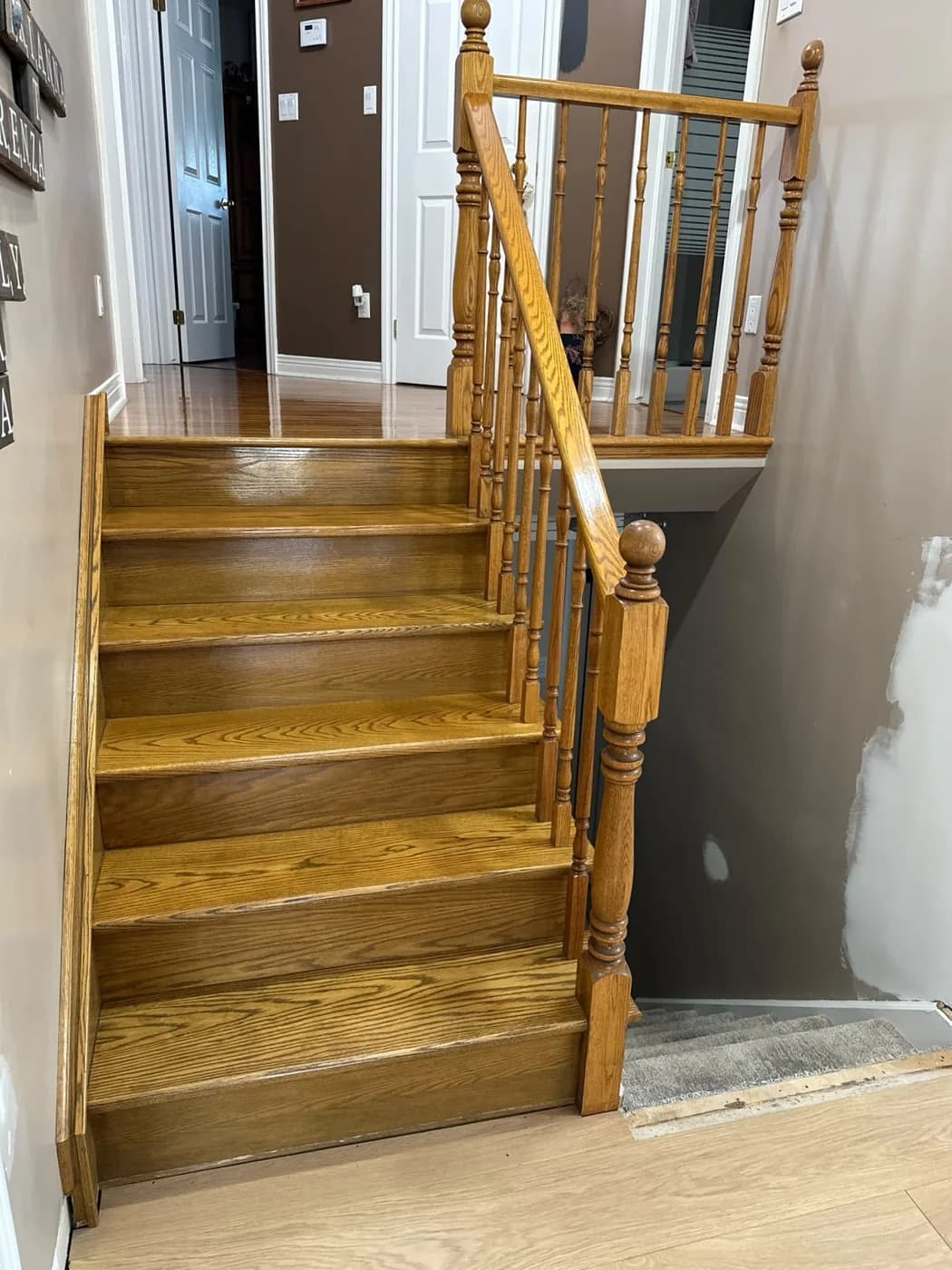
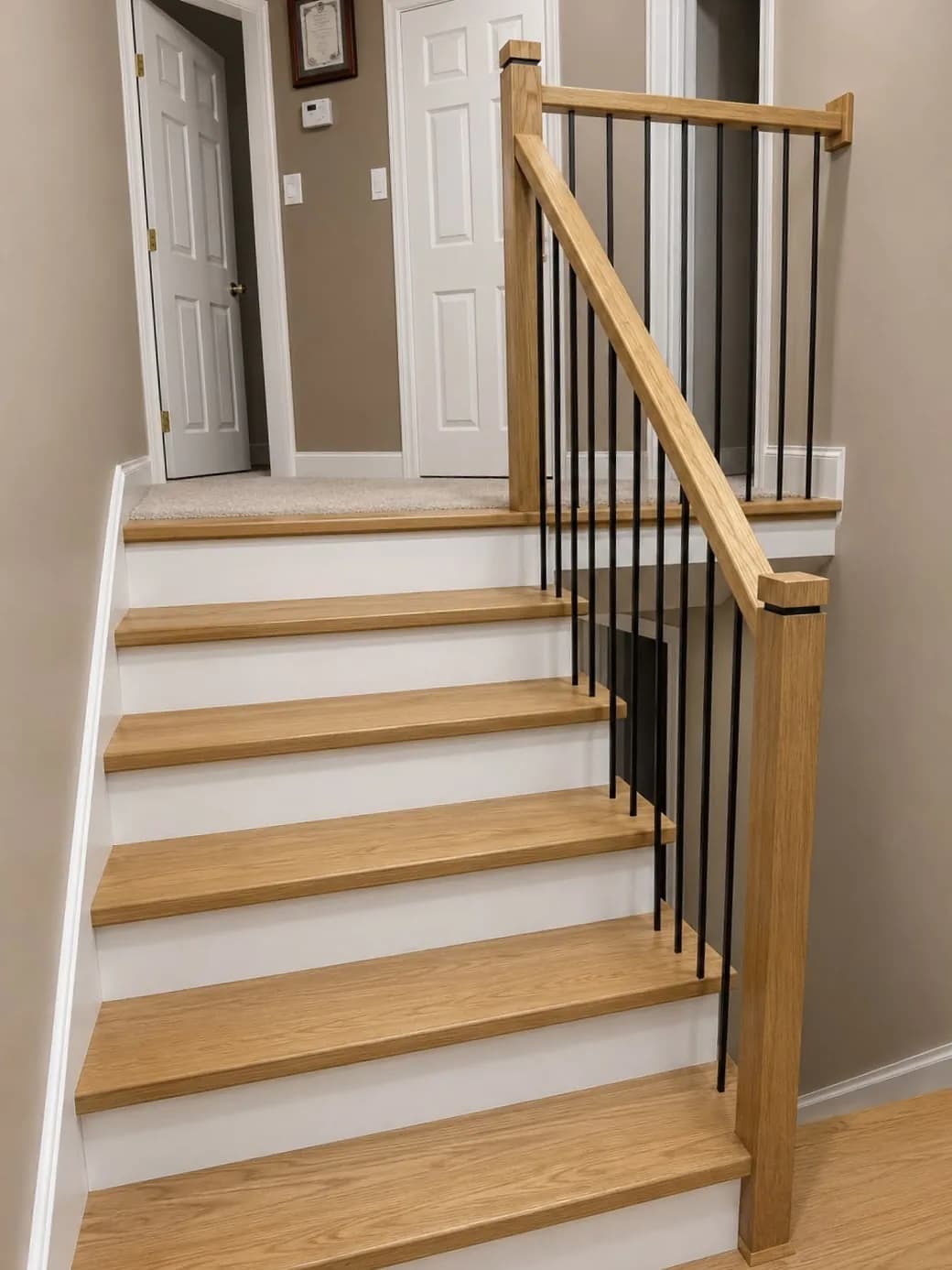
On a sound 13-tread staircase, a recap with red oak treads, white painted risers, oak handrail, and iron pickets is the highest-impact ~$5,500 you can spend on the inside of a Niagara home. We do dozens every year: treads milled and pre-finished in our climate-controlled shop on Lakeshore Road, installed by our own crew with no subcontractors on site.
When you should fully replace instead
Stop and rebuild if any of these are true. Recapping over a problem stair just glues hardwood to your headache.
- Persistent squeaking that doesn't resolve when treads are removed. Squeaks often live in the stringer-housing joint. Once you can see the structure with treads off, it's usually obvious, and refixing a stringer joint properly means redoing the rest anyway.
- Visible cracks or splits in the stringers, especially through-cracks at the inside corners of housings (where loads concentrate).
- Rot or moisture damage: common on basement stairs at Niagara homes with high water tables (south St. Catharines, parts of Welland, near the canal).
- Non-uniform rise/run. If treads vary by more than ~10 mm in rise from top to bottom, you're tripping on it without realizing: a recap inherits the problem. Replacement lets us correct it.
- Headroom under 1.95 m (6'5"): required minimum under OBC. An old staircase may have been built when this wasn't enforced; if you're permitting work, replacement might be your only path to compliance.
- You want to change the configuration (straight to L-shape, U to straight, relocate altogether). This always means new stringers.
- You want open risers, floating treads, or a steel mono-stringer. These systems can't be retrofitted onto closed stringers; they need a new structure.
Cost compared, side by side
For a typical 13-tread Niagara basement-to-main-floor stair (red oak, white risers, iron pickets and oak handrail):
- Recap: $4,800 – $6,200 + HST. Materials ~35%, labour ~55%, finish ~10%.
- Full replacement (same finish): $9,200 – $11,800 + HST. Materials ~30%, labour ~60%, finish ~10%.
- Difference: $4,400 – $5,600 buys you new stringers, corrected geometry, and zero structural compromises.
For full pricing across other configurations and finishes, see our 2026 custom stair cost guide.
Timeline reality
Both approaches involve the staircase being unusable for a stretch. Plan for the household to use a different route or be out for the install days.
- Recap: Total project ~5–10 working days. Demolition + tread install days 1–3 (stair usable end of day 3 with raw treads). Stain and 3 coats of polyurethane over the next week with overnight dry times. Pickets and handrail installed last.
- Full replacement: Total project ~8–14 working days. Add 2–4 days of framing/structural work and dust control. If permits are needed (structural changes, load-bearing wall removal), add 1–4 weeks lead time before work starts.
What a site visit actually checks
On a recap-vs-replace call, we're checking the same things every time: are the stringers structurally sound, is the rise/run uniform tread to tread, is there any squeak or deflection under weight, and what's the headroom clearance. If those come back clean, a recap can usually deliver a completely different look (new tread species, painted or stained risers, a glass or metal railing swap) without touching the structure underneath. See finished examples of both approaches in the gallery.
The 6-point checklist for Niagara homeowners
Before you book any contractor, walk your staircase with this list:
- 1. Does it squeak when you walk down at normal speed? (Yes = investigate further.)
- 2. Does the wall vibrate when you bounce mid-tread? (Yes = replacement.)
- 3. Are rises consistent from top to bottom (within ~10 mm)? (No = replacement.)
- 4. Is there visible rot, mould, or moisture staining on stringers? (Yes = replacement.)
- 5. Are you happy with the current location and layout? (No = replacement.)
- 6. Do you want open-riser, floating, or steel-stringer styling? (Yes = replacement.)
Five or six “recap-friendly” answers means you're a strong recap candidate. Two or more replacement triggers means rebuild. Anything else is throwing money at a problem you'll have to fix again later.
Frequently Asked Questions
Will a recap make my stairs feel different to walk on?
The geometry stays identical: same rise, same run, same length. What changes is the sound (hardwood is firmer than carpet, slightly louder), the surface (smoother, slightly more slippery in socks), and the visual proportions (treads can look thicker depending on nosing profile). Most homeowners describe the change as “tighter” and “more solid” even though structurally nothing under the surface has changed.
Can I recap and add a glass railing at the same time?
Absolutely. About a third of our recap projects include a new frameless or posted glass railing on the open side. The new railing is fastened into the existing stringer or to the floor framing, both of which we expose during the recap anyway. See our Ontario glass railing guide for code and system options.
How dusty is a recap vs full replacement?
Recaps generate carpet, staple, and finish dust, manageable with plastic sheeting at top and bottom of the stair and a HEPA shop-vac. Full replacements involve framing demolition and drywall patching, which produces significantly more dust over more days. We always seal off the work zone with 6-mil plastic and zipper doors before tearing in.
What about on stairs to a finished basement we use daily?
Recap is usually the right answer here precisely because of the disruption. We can rough in new treads in 1–2 days and you walk on raw treads while the finishing happens between site visits. A full replacement with the basement as the only access route can mean a full day where the basement is unreachable.
Does recapping void anything for resale?
No, a properly recapped stair is indistinguishable from a fully built stair to a buyer and to a home inspector. What matters is the visible quality, code compliance of the railing, and absence of squeaks. We've seen Niagara real estate listings explicitly highlight recently-recapped staircases as a feature.
How we do the assessment
Our free on-site visit takes about 30–45 minutes. We pull a corner of carpet, check stringer fastening, measure rise/run uniformity, confirm headroom, and inspect the existing railing connection. We give you a verbal recommendation on the spot and a written quote within 5 business days, for whichever direction (recap or replace) actually serves your house. What's included in each scope (materials, finish options, hardware) is laid out on our Recapping & Refinishing service page.
Not sure if your stair is a candidate for recapping?
We'll tell you straight: recap, replace, or just leave it. Free on-site assessment anywhere in the Niagara Region.
Get a Free EstimateLast updated: September 14, 2026. Pricing reflects 2026 Niagara Region material and labour costs. Code references reflect typical residential applications under the current Ontario Building Code.