What “custom” means in our shop
Off-the-shelf staircases are dimensioned for an idealized opening. Real Niagara homes (century homes in old St. Catharines, post-war bungalows in Welland, new builds in Niagara-on-the-Lake) almost never match the catalogue. Every staircase we deliver is modelled parametrically: each tread, riser, stringer and newel is computed from the actual rough-opening dimensions we measure on site, then cut on our CNC router with sub-millimetre repeatability.
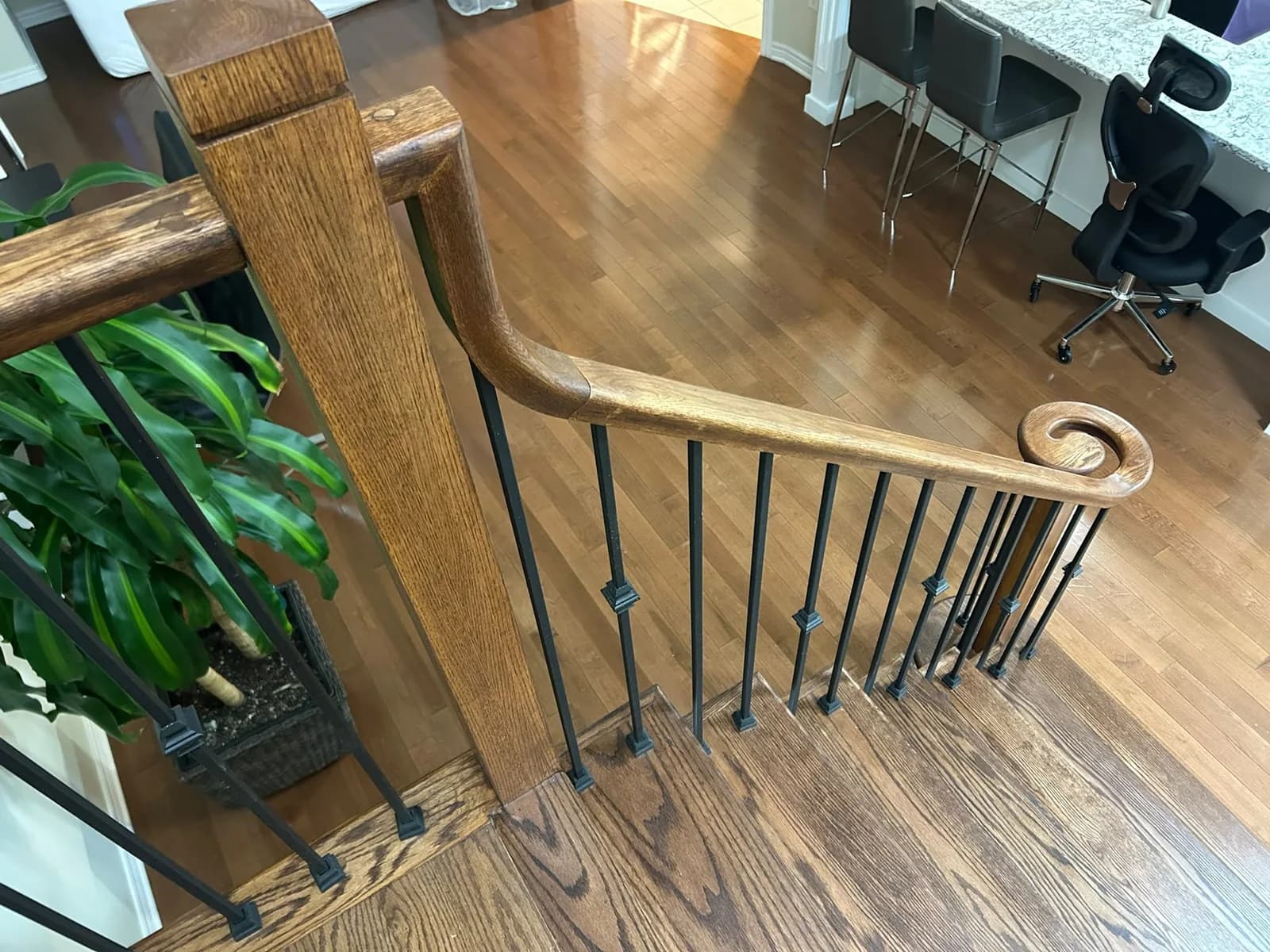
That precision lets us specify joinery that lasts: housed stringers with wedged treads, mortise-and-tenon newels, and dovetailed risers that won't squeak through the first ten Ontario winters. Glue-ups happen in our climate-controlled shop on Lakeshore Road, not in your living room.
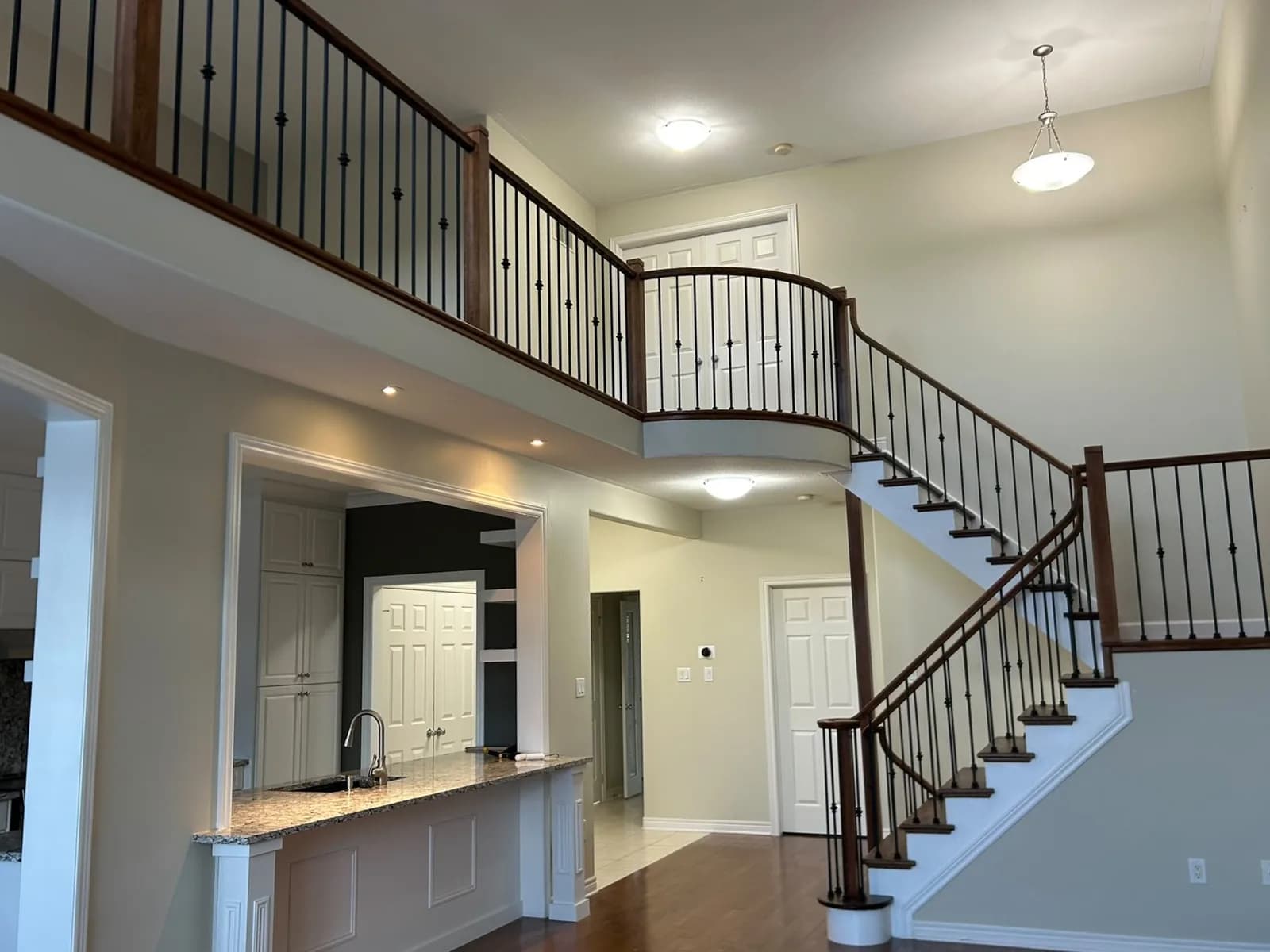
What you control at the outset is the form. A straight run is the most economical and the most common retrofit. A quarter-turn or half-turn landing redirects the climb and opens sightlines on a split-level plan. A U-shaped return fits a tighter footprint; floating and cantilevered designs (with structural steel stringers and open treads) let light pass through the stair and make it the architectural centrepiece of the room. We model every configuration from your rough-opening dimensions, so you see the geometry in CAD before a single board is cut.
Materials we work in
You specify the species and grade; we source board-selected hardwood stock from regional suppliers and build to a moisture-content spec that accounts for Niagara's climate range. Red oak remains the most-specified choice: stable, hard (Janka 1290), and forgiving of humidity swings between a 70%+ RH summer near the lake and a 20% RH January. White oak reads more contemporary and resists tannin pull-out under modern matte finishes. Hard maple takes a glass-smooth surface for lighter palettes; black walnut and hickory dominate feature stairs where a single open run sets the tone of the room. For mixed-material designs you might specify steel stringers with glass guards, or aluminum balustrade with a wood cap rail. We work in all of them.
Ontario Building Code compliance without compromise
Every set of drawings we produce honours the Ontario Building Code (O. Reg. 163/24) Section 9.8: maximum rise 200 mm, minimum run 255 mm, minimum tread depth 254 mm with a maximum 25 mm nosing, headroom no less than 1950 mm for dwelling units (2050 mm elsewhere), and a uniform variation tolerance of 5 mm across all risers. Handrails sit between 865 and 965 mm above the nosing line, and guards meet the 100 mm sphere rule for any opening below the rail. When a municipal inspector in St. Catharines or Niagara Falls asks for stamped drawings, we arrange them. You choose your guard configuration (glass panel, aluminum picket, wood baluster, or a combination) and we confirm the compliant geometry before fabrication begins.
Process and warranty
Every project follows the same five steps: free in-home consultation, parametric CAD design, CNC fabrication, hand-finishing, and installation by our own crew, no subcontracted installers. We serve St. Catharines, Niagara Falls, Welland, Thorold, Grimsby, and the surrounding communities, all within a short drive from our Lakeshore Road shop. Workmanship is guaranteed for ten years against squeaks, separation, and finish failure under normal residential use. See more finished staircases in our gallery, or jump to typical pricing on our pricing page.